 |
Emergency Management Organization

Shellmouth Dam Compensation Program
This is for information purposes only. A Shellmouth Dam Compensation Program has not been announced at this time.
Purpose of the Compensation Program
The Shellmouth Dam and Reservoir are owned by the province and serve several purposes. Their main goals are to reduce flood damage for downstream communities and to provide a steady water supply.
Many farmers own land along the Assiniboine River downstream of the dam. Flooding in the valley can damage crops and disrupt farm operations. In most cases, the dam reduces or prevents flooding. However, sometimes dam operations can cause water to stay on the land longer than it would naturally. This is called artificial flooding.
Artificial flooding happens when regulated river water levels are higher than natural levels, causing land to remain flooded for a longer time.
Not all flooding downstream of the Shellmouth Dam is artificial. Whether flooding is artificial depends on technical calculations that compare natural river levels with regulated levels. The Shellmouth Dam Compensation Program provides financial compensation to agricultural producers who experience economic losses and/or property damage caused by artificial flooding.
You may apply to the program if your agricultural property is located along the Assiniboine River between the Shellmouth Dam and Brandon, Manitoba and any of the following apply to you:
- You have experienced, or expect to experience, property damage caused by artificial flooding from the Shellmouth Dam.
- You have experienced, or expect to experience, economic loss because of artificial flooding from the Shellmouth Dam.
Compensation Program Steps
Take all reasonable steps to reduce damage to your property. Only take action if it is safe and practical to do so.
Actions may include:
- Moving cattle to a safe location
- Moving farm equipment to higher ground
- Restoring land so it can be used again
It is important to keep good records so your claim can be properly reviewed under the Shellmouth Dam Compensation Program.
Make sure you:
- Take clear photos of all damaged property and items before throwing anything away
- Keep records of all flood related work and repairs, including:
- Labour and equipment hours
- Materials used and amounts
- Equipment used (make, model, year, horsepower, and attachments)
- Extra mileage
- Extra feed and hay bales
When a period of artificial flooding begins, Manitoba Transportation and Infrastructure (MTI) will announce that impacted landowners and tenants may apply to the Shellmouth Dam Compensation Program using the online application form.
You should apply if you are already impacted or believe you may be impacted by the artificial flooding.
Important: Once you start the online application, you must complete it in one session. The form cannot be saved and finished later.
You can submit a claim up to 20 days after the artificial flooding period ends. MTI will also announce when the artificial flooding period is over.
After your application is reviewed and accepted into the program, Manitoba Emergency Management Organization (EMO) may ask for additional documents, including:
- Your most recent property tax bill to confirm ownership of the land included in your claim
- A Farmland Owner's Authorization, if you are a tenant making repairs on rented land with the landowner's approval
- Any other documents or information needed to process your claim
The Program Manager reviews each application as it is received to make sure all required information has been provided.
Manitoba Transportation and Infrastructure (MTI) staff will check that the property listed in the application is located within the artificial flooding area. MTI will publish flooding maps showing the maximum extent of flooding, including both natural and artificial flooding for each compensation program.
If your application is accepted, you will receive a letter by mail or email.
You must also provide your most recent property tax bill to confirm ownership of all land included in your application.
If it is decided that artificial flooding did not affect the land you applied for, you will be notified by letter. The letter will explain how you can appeal the decision if you disagree.
If it is decided that you may be eligible for compensation under the Shellmouth Dam Compensation Program, an inspection of your property will be arranged.
An on site inspection of your property will be arranged. An inspector from Manitoba Agricultural Services Corporation (MASC) will contact you to set a date and time that works for you.
Inspections will be completed within one month after floodwaters have returned to the riverbank.
How to Prepare for the Inspection
Please make sure:
- Someone is available to meet the inspector, preferably the person most familiar with the damage
- Someone is present who knows what repairs were made and what the property was like before repairs
- Photos are available to show conditions before repairs were completed
- You tell the inspector about all damage from the flooding, even if it has already been repaired
The inspector may not be able to see repairs that have already been done, so it is important to explain all damage during the visit.
After the inspection, MASC will send the inspection report to the Manitoba Emergency Management Organization (EMO).
If your claim includes non agricultural damage, a second inspection by a private adjuster may be needed. Manitoba EMO will contact you if a second inspection is required.
Manitoba EMO will share the inspection report and schedule of loss with you so you can review and confirm the information.
After the inspection is complete, your claim will be reviewed using the Compensation Guidelines created by the Technical Review Committee at the beginning of each compensation program. This review determines what compensation, if any, you may receive.
Your application is first evaluated by the Program Manager. It is then reviewed and approved by the Steering Committee. Once approved, you will receive a compensation statement package to review and accept.
Only damage caused fully or partly by artificial flooding is eligible for compensation.
How Artificial Flood Damage Is Calculated
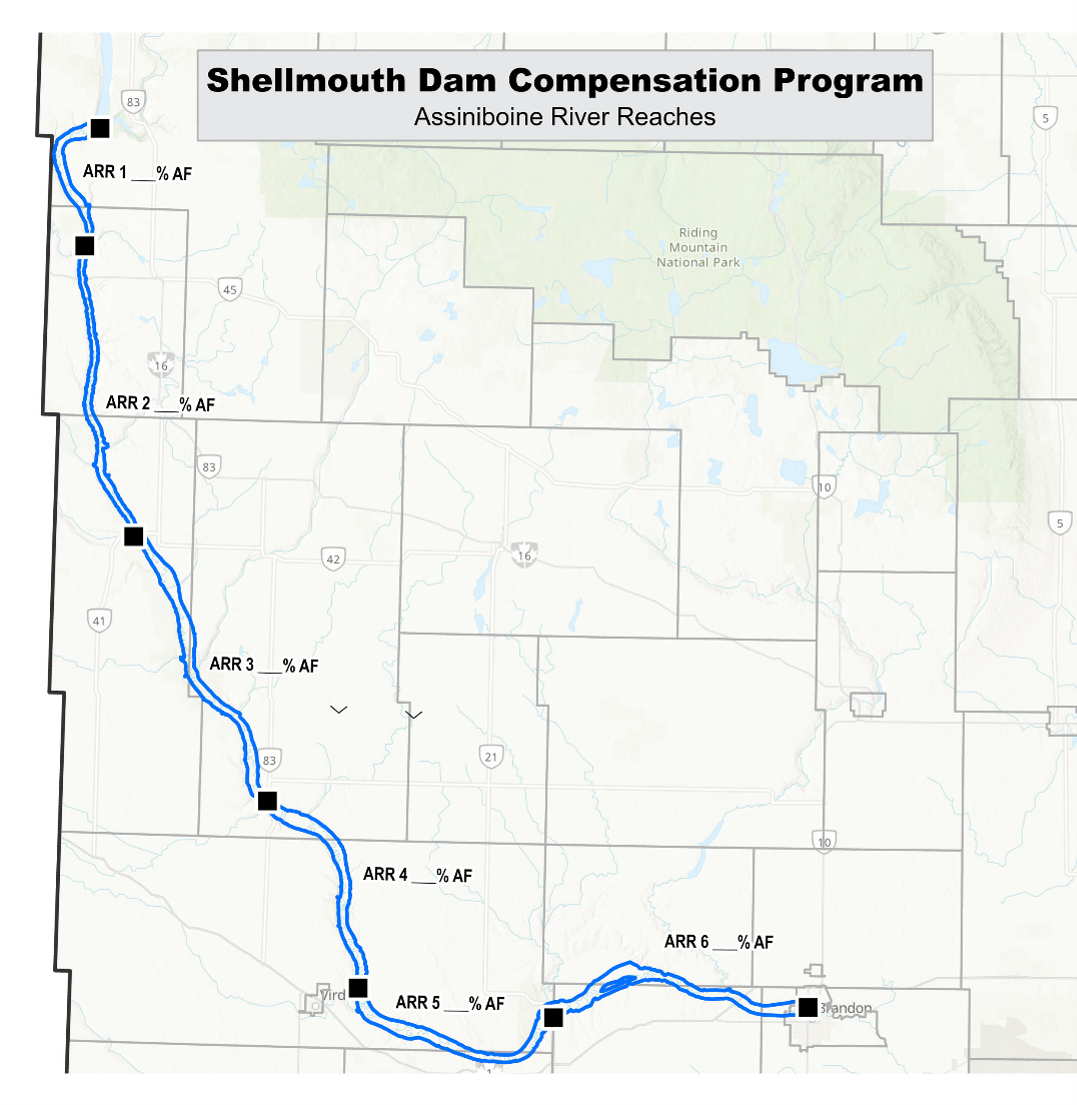
A simplified method is used to calculate artificial flood damage. Instead of assessing damage for each land parcel, Manitoba EMO estimates the average share of artificial flooding between six river gauge locations along the Assiniboine River.
Six reaches have been established and each reach has an average artificial flood percentage determined by the technical committee. Any damage partially caused by artificial flooding will be compensated based on the reach it is found in. This method is a balance between technical interpretation, program timelines and stakeholder feedback.
This approach is used to balance:
- Technical accuracy
- Timely processing of claims
- Fairness among similar claimants
The Technical Review Committee sets the average artificial flood proportions and overall compensation rules at the start of each compensation program. You receive compensation for artificial flooding only, not natural flooding.
Items That Are Commonly Eligible
The following items are usually eligible for compensation. If you are unsure about eligibility, contact Manitoba EMO.
- Livestock fencing
- Damaged crops
- Harvested and stored crops (bales, bushels, or piles)
- Minor silting, field erosion, and drainage cleaning
- Costs to evacuate livestock, such as pasture rental, boarding, and transportation
- Repair of damaged driveways, culverts, and similar structures
- Clean up and removal of debris
- Repair and restoration of outbuildings
- Repair of damaged pens and corrals
- Labour costs
You will receive a compensation statement package to review and accept. This package explains the total compensation offered by Manitoba for damage to your property caused by artificial flooding.
The compensation amount is based on:
- Damage recorded during MASC inspections and any secondary inspections
- Flood information provided by Manitoba Transportation and Infrastructure (MTI)
- The Compensation Guidelines
If you have questions about any part of the compensation package, you are encouraged to contact the Program Manager to discuss them.
You must respond within 30 days of receiving the compensation statement package. If needed, you may request a one time 30 day extension by contacting the Program Manager.
If you accept the compensation offer, your payment will be processed and issued.
If you believe the compensation offered does not fully cover the damage caused by artificial flooding, you may appeal the decision to the Manitoba Disaster Assistance Appeal Board. You may appeal all or part of the compensation amount.
If you are not satisfied with the compensation offered, you may appeal to the Disaster Assistance Appeal Board.
You must submit your appeal within 90 days of the date your compensation statement package was issued.
The board will review information from you and from Manitoba EMO before making a decision; a hearing may be held. All decisions must follow the compensation rules set out in sections 12.1 to 12.6 of the Water Resources Administration Act.
The board may decide to:
- Accept the appeal in part (change some compensation amounts)
- Accept the appeal in full (change compensation amounts)
- Dismiss the appeal (no change to compensation amounts)
The board's decision will be sent to you and to Manitoba EMO in writing. A board decision may not be appealed. Only questions of law can be appealed to The Court of Appeal.
Shellmouth Dam Compensation Program Engagement Sessions
On April 4, 2024 Manitoba Emergency Management Organization (EMO) held an engagement session at the Miniota Community Hall. The session focused on the Shellmouth Dam Compensation Program.
Manitoba EMO invited people who previously received compensation. They also invited members of the Shellmouth Dam Liaison Committee, local municipalities, producer groups and nearby Indigenous communities.
During the session Manitoba EMO shared updates on changes to improve the compensation program. These changes respond to five recommendations from the Office of the Auditor General released in August 2021. The recommendations followed a review of the 2011, 2012 and 2014 compensation programs.
Manitoba EMO first shared possible program changes at an engagement session in April 2022. Feedback from past claimants was carefully reviewed. This input helped shape a new program process that is easier to manage and quicker to deliver.
In April 2024, Manitoba EMO returned to explain the updated program process. They also outlined proposed regulation changes needed to support these improvements.
Link to the engagement session materials:
- Engagement session presentation
- SDCP Application
- Inspection Fact Sheet
- Inspection Guidebook
- SDCP Communication Strategy
- Feedback Station Questions
The session gave people a chance to share feedback on how the program is run. This included comments on program administration, inspections and communication.
Members of the public could also share comments online through EngageMB. The proposed regulation changes were open for public comment for 45 days, from February 29, 2024 to April 14, 2024.
Manitoba EMO thanks everyone who took part in the engagement session and shared their experiences and feedback. Based on what was heard Manitoba EMO removed the requirement for claimants to provide an oath or affirmation when submitting a claim.
The final regulation was submitted to the government for approval in summer 2024. It came into effect on June 28, 2024.
Key feedback from this engagement has been summarized in a What We Heard Report.
On April 26, 2022, Manitoba Emergency Management Organization (EMO) held an engagement session at the Miniota Community Hall. The session focused on the Shellmouth Dam Compensation Program.
Manitoba EMO invited people who had previously received compensation. They also invited members of the Shellmouth Dam Liaison Committee, local municipalities, producer groups and nearby Indigenous communities.
During the session Manitoba EMO shared updates on changes being made to improve the compensation program. In August 2021, the Office of the Auditor General released a report with five recommendations. The report reviewed the 2011, 2012, and 2014 Shellmouth Dam Compensation Programs.
Link to the engagement session materials:
- Engagement session presentation
- Individual engagement station presentations
Participants were able to share feedback on program administration, inspections and communication.
Manitoba EMO thanks everyone who took part in the session and shared their experiences and feedback. Key feedback from this engagement has been summarized in a What We Heard Report.