Health Care Directives in Manitoba
What is the purpose of a Health Care Directive?
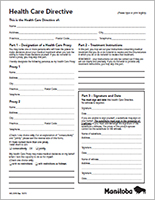 As a Manitoba citizen you have the right to accept or refuse medical treatment at any time. The Health Care Directives Act allows you to express your wishes about the amount and type of health care and treatment you want to receive should you become unable to speak or otherwise communicate this yourself. It also allows you to give another person the power to make medical decisions for you should you ever be unable to make them yourself.
Why should I fill out a form?
Due to accident or illness, you may become unable to say or show what treatment you would like, and under what conditions. If you have signed a directive, those close to you and the health care professionals treating you are relieved of the burden of guessing what your wishes might be.
How do I make a Health Care Directive?
The Manitoba government has prepared a form for your convenience (see below). The form serves as a guide for providing the appropriate information. However, any paper that is signed, dated and provides the same information may be used. A directive may be made by anyone capable of making a health care decision and understanding the consequences of that decision. If you are unable to sign the form yourself, a substitute may sign on our behalf. The substitute must sign the form in your presence and the presence of a witness, or you may acknowledge the signature of the substitute to a witness using videoconferencing. If witnessing is done through videoconferencing, you must provide the original directive signed by the substitute to the witness for signature after the videoconference. A proxy named in the directive and the proxy's spouse cannot be a witness. Further information on the remote witnessing requirements can be accessed through the following link: https://web2.gov.mb.ca/laws/regs/current/_pdf-regs.php?reg=82/2021
Who do I talk to about these decisions?
It is strongly recommended you talk to your doctor before completing the directive. This will ensure your instructions are clear and easily understood by those who provide treatment. Your choices should then be clearly typed or printed.
What is a proxy?
A proxy is someone you choose and name in your directive to act for you in the event you are not able to make such judgments and speak on your own behalf. Because it is not possible to anticipate every set of circumstances, your proxy has the power to make health care decisions for you based on what you have told your proxy about your wishes and the information in your directive.
Who do I choose as my proxy?
The choices you make in a directive are very personal. The person(s) you choose to represent you should be close friends or relatives who are willing to accept this responsibility. You should discuss your wishes openly and in detail with them. It is wise to name more than one proxy in case one is not available when needed.
If you designate two proxies, you must decide how you want them to work, either independently or together as a team. If you decide the two proxies should act jointly, they will act together on your behalf. If you decide they should work consecutively, the second proxy will be contacted if the first is not available or is unwilling to make the required decision at the required time.
It is important to make sure that your proxy (or proxies) understand(s) what is expected and is willing to speak and act for you.
Can I change my mind about my directive?
A Health Care Directive should be a record of your current wishes. If at any time you wish to change the content or the proxies you have listed, all copies of your old directive should be destroyed and a new directive written.
What is the effect of a Health Care Directive?
The wishes you express in your directive are binding on your friends, relatives and health care professionals (unless they are not consistent with accepted health care practices) and will be honoured by the courts. However, health care professionals treating you are not obliged to search for or ask about a signed directive. It is important to be sure that family, friends, your doctor and your proxy know you have a directive and know where it can be found.
Can a proxy give consent for Medical Assistance in Dying (MAID) in Manitoba?
No, a proxy or substitute decision maker cannot provide consent for MAID. For more information on MAID, please visit www.gov.mb.ca/health/maid.html

For more information, please contact your Regional Health Authority.