

Curly-leaf Pondweed (Potamogeton crispus)
What is Curly-leaf Pondweed?
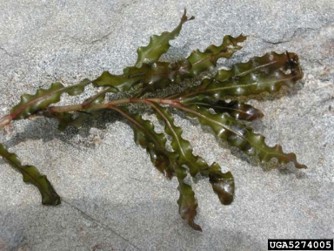
Curly-leaf Pondweed is a submerged aquatic plant that is not native to North America. It is native to Europe, Asia, and Australia
Why is it an issue?
Curly-leaf Pondweed is a concern to Manitoba because plants can:
- establish quickly and earlier in the growing season outcompeting native aquatic plants reducing biodiversity.
- reproduce by fragmentation where the smallest plant fragment can create an entirely new plant. Plants can also create “buds” called turions that germinate in the late fall.
- tolerate low light and low temperature conditions. Unlike native aquatic plants, Curly-leaf Pondweed can start to grow under ice late in the closed water season.
- create dense mats impeding water intake systems and interfere with recreational activities like swimming, fishing and boating.
- cause more frequent algal blooms due to plants releasing nutrients when they dieback much earlier (i.e., mid- July) than native plants.
- become entangled in propellors and other water related equipment (such as trailers, nets, and ropes) and be spread to new water bodies by human-mediated transport.
Once established Curly-leaf Pondweed is nearly impossible to eradicate.
Prohibition
Curly-leaf Pondweed is designated as an aquatic invasive species (AIS) in Manitoba.
In Manitoba, it is illegal to knowingly or unknowingly:
- possess a member of an AIS in Manitoba
- bring a member of an AIS into Manitoba or cause it to be brought into Manitoba
- deposit or release a member of an AIS in Manitoba or cause it to be deposited or released in Manitoba
- transport a member of an AIS in Manitoba
Where is Curly-leaf Pondweed found in Manitoba?
Curly-leaf Pondweed has been detected in:
- Lake Metigoshe (Canadian portion) in 2026
- First Cranberry Lake in 2026
How did Curly-leaf Pondweed get to Manitoba?
Curly-leaf Pondweed was initially introduced to North America in the mid 1800s. There is an established presence of Curly-leaf Pondweed in nearly all 50 US states and much of Southern Canada.
Since the initial introduction, human-induced movement has allowed Curly-leaf Pondweed to expand to other water bodies by movement of uncleaned watercraft and water-related equipment.
Curly-leaf Pondweed was detected in Canadian portion of Lake Metigoshe and First Cranberry Lake in 2026.
How to Identify Curly-leaf Pondweed?
Curly-leaf Pondweed can be identified by:
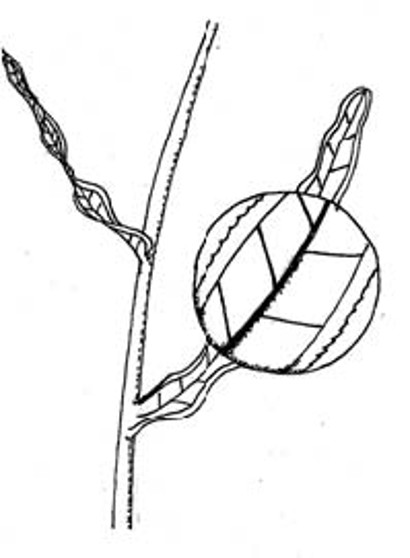
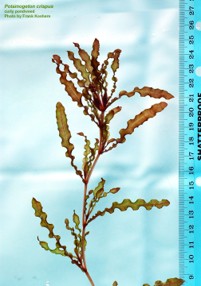
- Distinct wavy leaves with serrated edges (resembling narrow lasagna noodles) and lobed ends
- Leaves arranged in a whorled pattern around the stem
- Leaves can range in colour from reddish-brown to green
How to stop the spread of Curly-leaf Pondweed in Manitoba
The most effective prevention is to stop the human-caused movement, introduction and spread of Curly-leaf Pondweed. All water-users play a role in preventing the introduction and spread of Curly-leaf Pondweed. Prevention is our best defense.
Curly-leaf Pondweed can easily become entangled in propellors, trailers, and other water-related equipment. It is crucial to remove all aquatic plants, mud and other biological material from your watercraft and trailer before leaving the shore of a water body.
The AIS Open-water Season and Winter (Ice-covered) Season checklists are step-by-step resources that can help you prevent the spread of Curly-leaf Pondweed and comply with the Manitoba government's AIS Regulation.
Set fines for AIS offences are in effect year-round.
What should you do if you see an AIS such as Curly-leaf Pondweed?
If you see Curly-leaf Pondweed in a water body where it is not known to exist, note the location, take pictures and report to the Manitoba government's AIS Unit by:
- emailing AIS@gov.mb.ca
- calling 1-877-867-2470
Created July 2026
