

Assessing the impact of tariffs on the labour market is difficult given the uncertainty about which tariffs will be implemented, how long they will be in effect and what retaliatory measures will be implemented.
The Manitoba government will continue to actively monitor the impact of tariffs on the workforce and will provide updated labour market projections when they are available.
Regional Forecast
Manitoba has six economic regions with unique economic and labour market conditions that determine available employment opportunities and labour demand.
Figure 1: Five-year Job Openings by Economic Region.
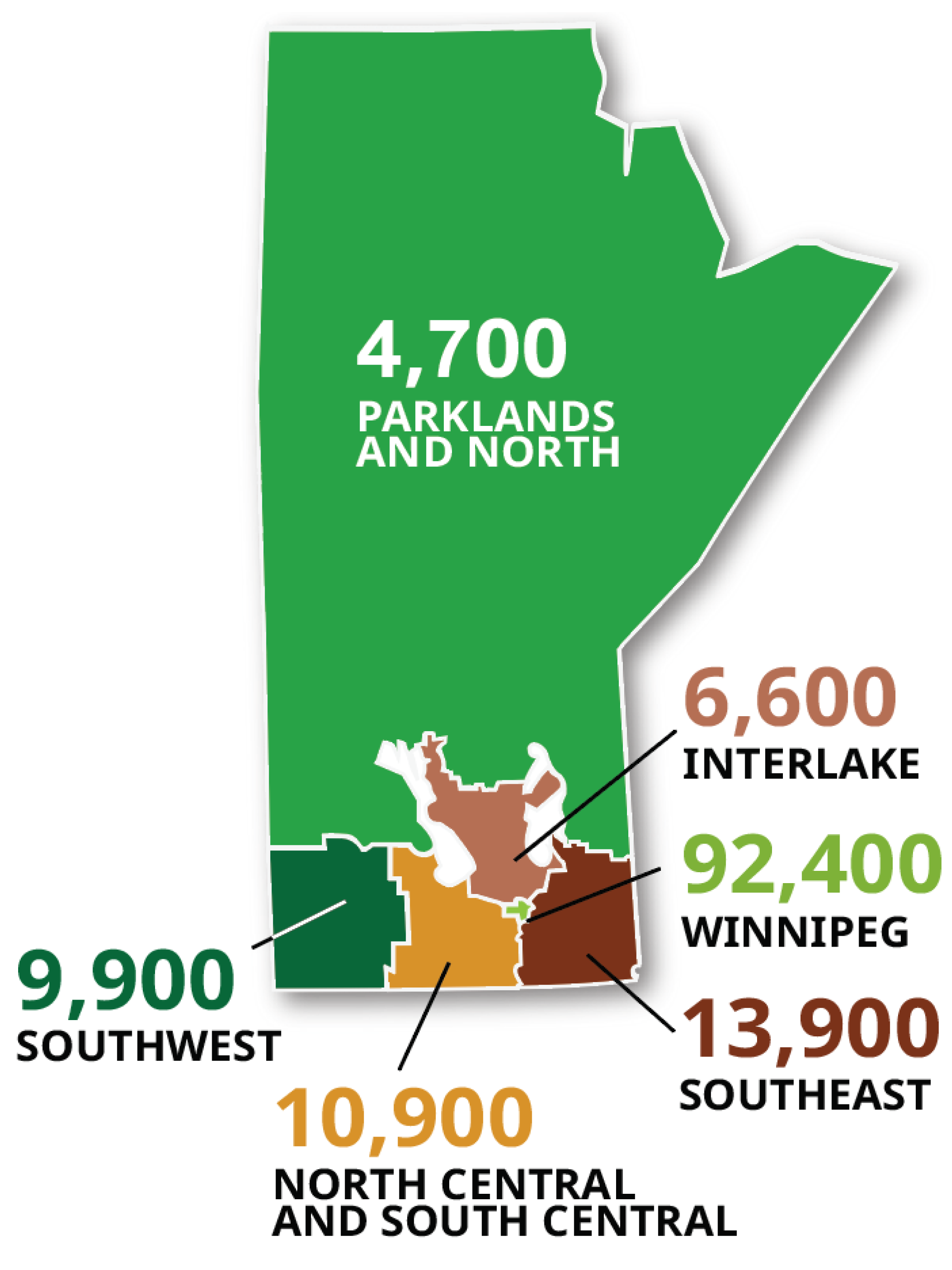
| Regions | Total Job Openings 2025-2029 |
| Winnipeg | 92,400 |
| Southeast | 13,900 |
| North Central and South Central | 10,900 |
| Southwest | 9,900 |
| Interlake | 6,600 |
| Parklands and North | 4,700 |
| TOTAL | 138,400 |
Table 1: Employment and Job Openings Across Economic Regions in Manitoba, 2025 to 2029.
| Region | Employed | 2024 Actual Labour Force Participation Rate | Unemployment Rate | Five-Year Employment Growth Rate1 2025–2029 |
Job Openings2 2025-2029 | ||
| Expansion Demand |
Replacement Demand |
Total Job Openings | |||||
| Winnipeg | 442,800 | 67.8% | 5.7% | 9.5% | 43,200 | 49,200 | 92,400 |
| Southeast | 70,600 | 68.7% | 4.3% | 8.1% | 6,100 | 7,800 | 13,900 |
| North Central and South Central |
60,600 | 64.9% | 5.1% | 6.8% | 4,100 | 6,800 | 10,900 |
| Southwest | 58,800 | 66.9% | 4.9% | 5.8% | 3,400 | 6,500 | 9,900 |
| Interlake | 48,600 | 60.5% | 4.8% | 0.9% | 800 | 5,800 | 6,600 |
| Parklands and North | 34,600 | 61.9% | 6.6% | 3.0% | 1,100 | 3,600 | 4,700 |
| TOTAL | 716,600 | 66.8% | 5.4% | 8.0% | 58,700 | 79,700 | 138,400 |
1 Values under 5-Year Employment Growth Rate 2023-2027 correspond to the cumulative growth rate for the entire 5-year period.
2 Job Openings by Expansion and Replacement correspond to the total 5-year forecast period.
Note: The total number of job openings identified in this table varies from the overall provincial total due to some differences in the data available at a regional level and rounding of numbers.
Winnipeg Region
The Winnipeg economic region is made up of the City of Winnipeg and the Rural Municipality of Headingley census subdivisions and is home to over half of Manitoba’s population.
In 2024, the region had an estimated employed workforce of 442,800, the second-highest unemployment rate in Manitoba at 5.7% and the second-highest labour force participation at 67.8%
The Winnipeg region’s three largest industries based on employment are healthcare and social assistance, wholesale and retail trade, and manufacturing.
The following table presents the estimated job openings by National Occupational Classification (NOC) occupational category between 2025 and 2029 in the Winnipeg region.
Job openings are expected to be highest in business, finance and administration occupations (17,600), sales and service occupations (17,200), education, law and social, community and government services (13,300), and trades, transport and equipment operators and related occupations (13,200).
Table 2: Five-Year Job Openings by NOC Occupational Category for the Winnipeg Region.
| National Occupational Classification — Occupational Category Title | |||
| 5,000 | |||
| 7,800 | |||
| Occupations in art, culture, recreation and sport, except management | 1,200 | 1,100 | 2,300 |
| Total |
Southeast Region
The Southeast region is the second most populated region in Manitoba and is made up of census divisions 1, 2 and 12. Its largest communities include Steinbach, Niverville, Powerview-Pine Falls and Lac du Bonnet.
In 2024, the region had an estimated employed workforce of 70,600, the lowest unemployment rate in Manitoba at 4.3% and the highest labour force participation rate at 68.7%
The Southeast region’s three largest industries based on employment are construction, wholesale and retail trade, and healthcare and social assistance.
The following table presents the estimated job openings by National Occupational Classification (NOC) occupational category between 2025 and 2029 in the Southeast region.
Job openings are expected to be highest in trades, transport and equipment operators and related occupations (3,200), business, finance and administration occupations (2,400), sales and service occupations (2,300), and management occupations (1,800).
Table 3: Five-Year Job Openings by NOC Occupational Category for the Southeast Region.
| National Occupational Classification — Occupational Category Title | |||
| Occupations in art, culture, recreation and sport, except management | 200 | 100 | 300 |
| Total |
North Central and South Central Regions
The North Central region is made up of census divisions 8, 9 and 10 and the South Central region is made up of census divisions 3 and 4. Combined, they are the fourth most populous Manitoba region with major centres including Winkler, Portage la Prairie, Morden and Altona.
In 2024, the regions had a combined estimated employed workforce of 60,600 individuals, the fourth lowest unemployment rate in Manitoba at 5.1% and a labour force participation rate of 64.9%.
The North Central and South Central regions’ three largest industries based on employment are manufacturing, wholesale and retail trade, and healthcare and social assistance.
The following table presents the estimated job openings by National Occupational Classification (NOC) occupational category between 2025 and 2029 in the North Central and South Central regions combined.
Job openings are expected to be highest in occupations in trades, transport and equipment operators and related occupations (2,800), education, law and social, community and government services (2,100), and business, finance and administration occupations (1,900).
Table 4: Five-Year Job Openings by NOC Occupational Category for the North Central and South Central Regions.
| National Occupational Classification — Occupational Category Title | |||
| 0 | |||
| Occupations in art, culture, recreation and sport, except management | 200 | 100 | 300 |
| Total |
Southwest Region
The Southwest region is made up of census divisions 5, 6, 7 and 15, is the third most populous region and includes the province’s second-largest city, Brandon.
In 2024, the region had an estimated employed workforce of 58,800 individuals, the third-lowest unemployment rate in Manitoba at 4.9% and the third-highest labour force participation at 66.9%.
The Southwest region’s three largest industries based on employment are healthcare and social assistance, wholesale and retail trade, and manufacturing.
The following table presents the estimated job openings by National Occupational Classification (NOC) occupational category between 2025 and 2029 in the Southwest region.
Job openings are expected to be highest in sales and service occupations (2,000), trades, transport and equipment operators (1,600), education, law and social, community and government services (1,600), and business, finance and administration occupations (1,400).
Table 5: Five-Year Job Openings by NOC Occupational Category for the Southwest Region.
| National Occupational Classification — Occupational Category Title | |||
| Occupations in art, culture, recreation and sport, except management | 200 | 100 | 300 |
| Total |
Interlake Region
The Interlake region is made up of census divisions 13, 14 and 18. It is the fifth-largest Manitoba region by population and includes the communities of Selkirk, East St. Paul, West St Paul and Stonewall. Many individuals commute daily from these population centres to the City of Winnipeg for work.
In 2024, the region had an estimated employed workforce of 48,600 individuals, the second lowest unemployment rate in Manitoba at 4.8% and the lowest labour force participation rate at 60.5%.
The Interlake region’s three largest industries based on employment are wholesale and retail trade, healthcare and social assistance, and construction services.
The following table presents the estimated job openings by National Occupational Classification (NOC) occupational category between 2025 and 2029 in the Interlake region.
Job openings are expected to be highest in trades, transport and equipment operators and related occupations (2,000) and management occupations (1,600).
Table 6: Five-Year Job Openings by NOC Occupational Category for the Interlake Region.
| National Occupational Classification — Occupational Category Title | |||
| Occupations in art, culture, recreation and sport, except management | -100 | 0 | -100 |
| Total |
Parklands and North Regions
The Parklands region is made up of census divisions 16, 17 and 20 and the North region is made up of census divisions 19, 21, 22 and 23. Combined, they are the largest region in Manitoba by area, but the smallest in terms of employment. The two regions rely on natural resource extraction for a significant proportion of their economic activity. Major population centres include Thompson, Dauphin, The Pas and Flin Flon.
In 2024, these regions were estimated to have an employed workforce of 34,600 individuals, excluding employment in First Nations communities. The region had an unemployment rate of 6.6% (the highest in the province) and a labour force participation rate of 61.8%. (the second lowest in Manitoba).
The Parklands and North regions’ three largest industries based on employment are healthcare and social assistance, wholesale and retail trade and educational services.
The following table presents the estimated job openings by National Occupational Classification (NOC) occupational category between 2025 and 2029 in the Parklands and North regions.
Job openings are expected to be highest in sales and service occupations (1,300), management occupations (900), education, law and social, community and government services (700), and trades, transport and equipment operators and related occupations (600).
Table 7: Five-Year Job Openings by NOC Occupational Category for the Parklands and North Regions.
| National Occupational Classification — Occupational Category Title | |||
| 400 | |||
| Occupations in art, culture, recreation and sport, except management | 0 | 0 | 0 |
| Total |
