Assessing the impact of tariffs on the labour market is difficult given the uncertainty about which tariffs will be implemented, how long they will be in effect and what retaliatory measures will be implemented.
The Manitoba government will continue to actively monitor the impact of tariffs on the workforce and will provide updated labour market projections when they are available.
Workers
Key Facts
- Manitoba is projected to have a labour force of 813,800 people by the end of the five-year period, in 2029.
- New entrants, immigrants and other mobility are expected to add 104,000 new workers to Manitoba’s labour market from 2025 to 2029. Interprovincial migration, retirements and deaths are expected to result in a loss of 103,700 workers.
This information can help government, educational institutions, and industry gain a better understanding of the components of Manitoba’s future workforce and support planning efforts to increase labour supply from specific sources to address potential shortfalls in the labour market.
However, it is important to recognize that this data is intended to provide a broad overview and may not contain the level of detail required to draw conclusions about specific occupations or disciplines. All forecasting models, including the Labour Market Outlook, are based on assumptions and historical trends that may not fully capture the impact of sudden or localized changes. As such, this information should be used as one of several tools to support planning and decision-making.
Local and regional labour market intelligence—such as community-level data, employer insights, and sector-specific trends—should also be considered when assessing occupational demand and workforce needs. These sources can provide critical context and nuance that may not be reflected in province-wide projections.
What are the current and future characteristics of Manitoba’s workforce?
In 2024, Manitoba’s labour force was 766,200 workers. It is expected that this number will rise to 813,800 by 2029, which is an increase of 47,600 total workers or 9,520 workers per year.
Figure 6: Manitoba Labour Force (Actual and Projected)*, 2024 to 2029.
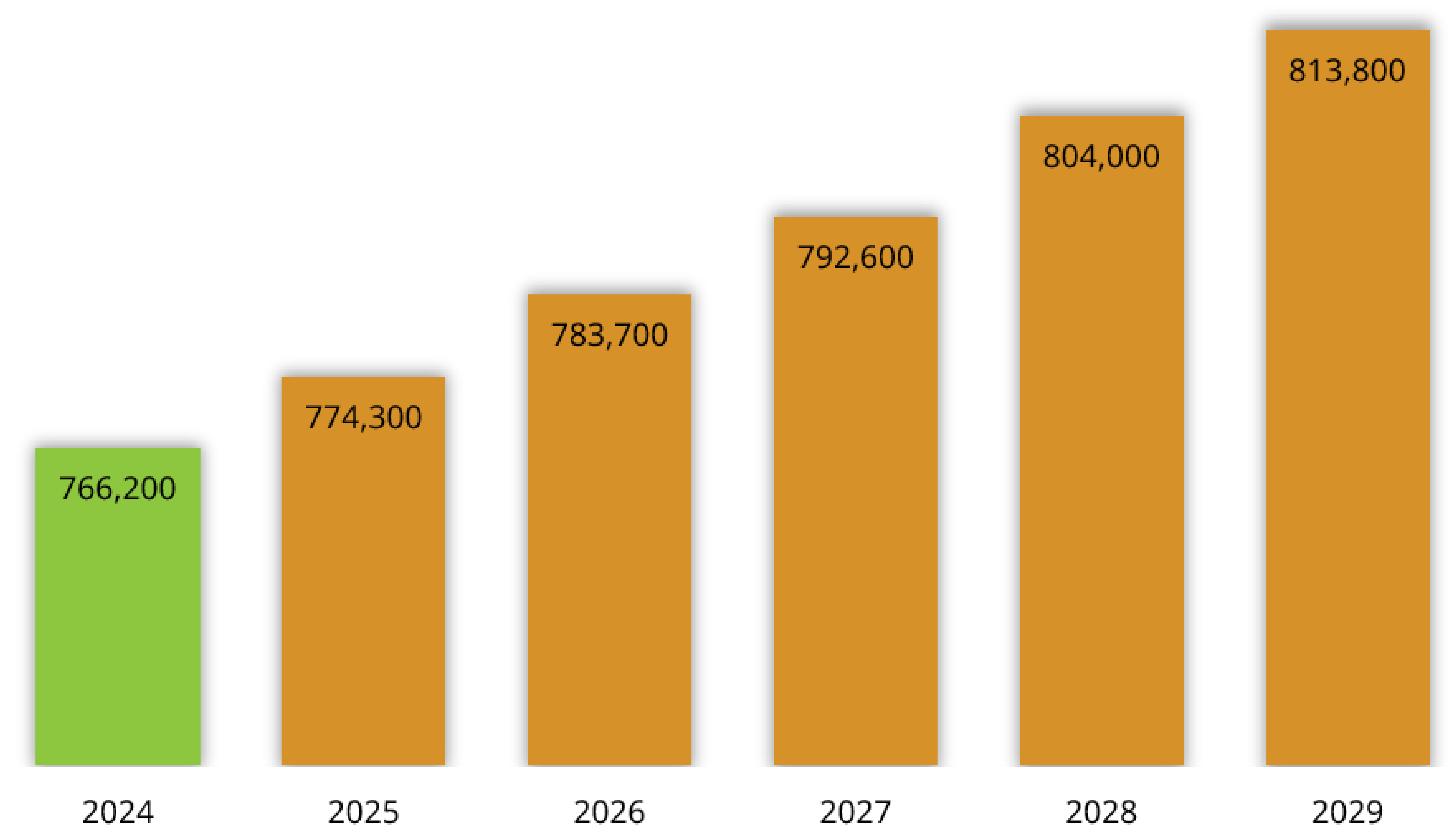
* The figure for 2024 is the actual labour force. The figures for years 2025 to 2029 are the projected labour force.
Factors influencing Manitoba’s future workforce
Several factors will influence changes in the available workforce.
Losses:
- Interprovincial migration – Between 2025 and 2029, Manitoba is projected to lose 24,000 more workers than it will gain from other provinces and territories. The top three provinces Manitoba loses workers to are Ontario, Alberta and British Columbia.
- Retirements and deaths – 79,700 workers (around 16,000 per year) are projected to leave the workforce due to retirements and deaths by the end of 2029.
Gains:
- New entrants – An estimated 63,500 new entrants (12,700 per year) are projected to join Manitoba’s workforce for the first time after completing their education.
- Immigration – International immigration will remain a key contributor to Manitoba’s population and workforce growth, with an estimated 33,500 immigrant workers expected to join the labour force over the next five years. However, due to federal policy changes introduced in fall 2024, immigration levels are projected to decline from 2025 to 2027 compared to recent years. While still an important source of workforce supply, the anticipated numbers are lower than historical trends.
Table 1: Sources of Labour Force Change, 2025 to 2029*.
| Total | ||||||
| 63,500 | ||||||
| 33,500 | ||||||
| 7,000 | ||||||
| -13,500 | ||||||
| -24,000 | ||||||
| -66,200 |
* Except for immigration numbers, this table assumes that labour force changes are equally distributed over the five-year forecast.
1Immigration numbers exclude Temporary Foreign Workers (TFWs). The projections are based on Stokes Economics Custom Table, “January Population Forecast 2025”, and incorporate the immigration policy changes implemented by Canada in Fall 2024.
2 Net other mobility includes individuals rejoining the workforce after a time away, and those returning to work, such as seasonal workers.
The 2025 to 2029 Manitoba Labour Market Outlook projections indicate that while our labour market is relatively balanced today, the supply of workers will outpace the availability of open jobs over the five-year forecast period. Despite this, certain occupations will experience labour shortages and will remain unfilled. This can be attributed to skills mismatches, where workers with the required skills for specific jobs are not available.