Comparing Zero And Conventional Tillage
*Click thumbnail images to enlarge photograph.
Tillage Loss Leaves Questions
The types and number of weeds in any given field are controlled by a number of factors: soil types, environmental conditions, crop rotations, herbicides used, and tillage - to name a few. However, with the trend towards zero tillage or direct seeding, an important weed control tool has been reduced or eliminated.
Farmers can compensate for the loss of tillage by increasing their reliance on other weed management tools, such as crop rotations and herbicide use. However, this still leaves us with a number of questions. How much of an effect does the loss of tillage really have on weeds? Which weeds should we be paying more attention to? How do we compensate for the loss of tillage?
Survey Looks For Answers
In order to answer some of these questions, a weed survey comparing zero and conventional tillage systems in Manitoba was conducted. Approximately 130 zero and conventional tillage fields were surveyed in 1994, from 27 rural municipalities across Manitoba. For each zero tillage field surveyed, a conventional tillage field was selected nearby that had a similar crop rotation history.
To qualify as a zero tillage field, three years of zero tillage production were required. As well, only fields seeded with knife, spoon or disc type openers were used; those on which cultivator shovels were used at seeding time did not qualify. Fall anhydrous applications were allowed on zero tillage fields, but only if low disturbance knives were used.
Fields qualified under the conventional tillage category if there was a minimum of two tillage operations before seeding (in the spring or previous fall).
The survey sampled both types of fields for weeds in the spring, before spraying, and again in the fall, after harvest. The centre part of each field was sampled, as well as the border, to look for weeds that might have been encroaching from the field's edge.
Results Show Differences In Weed Populations
According to the survey, many perennial weeds had higher densities in zero tillage fields - as well as some annual weeds. However, other annual weeds had higher densities in conventional tillage systems (see Survey Results Charts). Annual weeds included grassy and broadleaf weeds, and volunteer crops.
Annual weeds that had lower densities in zero tillage fields included redroot pigweed, green foxtail and kochia. These weeds have better germination and growth at higher soil temperatures, and the lower densities could reflect lower soil temperatures in the spring in zero tillage systems.
Differences were also observed in weed populations in field borders and the main body of both types of fields. Some weed species had higher densities in the borders, while an equal number had higher densities in the main area of the fields (see Survey Results Charts).
This is an important observation, since it has been suggested that weeds such as dandelion and Canada thistle (with seeds that are spread by wind) might be more abundant in the borders of zero tillage fields - because their seeds are trapped by stubble and litter as they blow in. However, the survey did not indicate this; if these weeds are being spread by wind, they are moving into the main body of the fields as well.
It should be noted that the consistent increase of perennial weeds such as dandelion, perennial sow-thistle, Canada thistle and quackgrass in zero tillage fields has been and still is a concern.
Survey Results Charts
Weeds With Higher Densities In Zero Tillage Fields
| Weed | Zero Tillage Density (#/m2) |
Conventional Tillage Density (#/m2) |
| Dandelion | 7.0 | 1.0 |
| Perennial sow-thistle | 2.8 | 1.8 |
| Canada thistle | 12.9 | 5.3 |
| Quackgrass | 14.8 | 6.1 |
| Wild oats | 29.8 | 20.1 |
| Volunteer canola | 140.8 | 63.7 |
| Cleavers | 1.9 | 0.4 |
| Hemp nettle | 2.1 | 1.3 |
| Round-leaved mallow | 9.0 | 0.7 |
Weed With Higher Densities In Conventional Tillage Fields
| Weed | Zero Tillage Density (#/m2) |
Conventional Tillage Density (#/m2) |
| Green foxtail | 22.2 | 33.1 |
| Volunteer barley | 0.9 | 3.6 |
| Wild mustard | 15.6 | 40.6 |
| Redroot pigweed | 1.6 | 9.2 |
| Volunteer flax | 17.1 | 54.7 |
| Night flowering catchfly | 1.4 | 3.0 |
| Kochia | 0.4 | 16.3 |
| Lamb's-quarters | 4.1 | 19.5 |
Weeds With Higher Densities In Borders Of Fields - Both Systems
| Weed | Zero Tillage Density (#/m2) |
Conventional Tillage Density (#/m2) |
| Redroot pigweed | 6.8 | 4.0 |
| Shepherd's purse | 10.8 | 5.8 |
| Stinkweed | 10.1 | 6.3 |
| Kochia | 16.3 | 0.6 |
| Round-leaved mallow | 8.9 | 0.7 |
Weeds With Higher Densities In Centres Of Fields - Both Systems
| Weed | Zero Tillage Density (#/m2) |
Conventional Tillage Density (#/m2) |
| Quackgrass | 6.8 | 13.9 |
| Wild oats | 18.7 | 31.0 |
| Volunteer canola | 80.2 | 123.4 |
| Wild buckwheat | 6.0 | 9.7 |
| Night flowering catchfly | 1.3 | 3.1 |
Producer Practices Provide Additional Information
Producers involved in the survey were asked to complete a questionnaire, to better understand differences in weed management between zero and conventional tillage production. Producers were questioned on all aspects of their weed management program, including chemical and cultural control practices.
Zero and conventional tillage practices differed in some areas:
- Pre-seeding herbicide use. All zero tillage producers surveyed used pre-seeding Roundup, while conventional tillage producers did not use Roundup as extensively prior to seeding.
- Soil-applied herbicides. Soil-applied herbicides were used much more extensively in conventional tillage systems compared with zero tillage production. Many zero till producers did, however, report making surface applications of these products.
- Cultural weed control strategies. Zero tillage producers may rely more heavily on non-chemical weed control methods such as alternating seeding dates, the use of heavy seeding rates and shallow seeding, and fertilizer banding - when compared with conventional tillage producers.
- Fall spraying for winter annuals. The majority of zero tillage producers sprayed for winter annual weeds in the fall, while conventional tillage producers did not spray for winter annual weeds.
| On the other hand, for perennial weed control, zero and conventional tillage producers reported virtually identical practices. Even though the survey showed that zero tillage fields had higher densities of perennial weeds than conventional tillage fields, the in-crop, pre-harvest and post-harvest herbicide use for perennial weed control may not differ between zero and conventional tillage systems. | 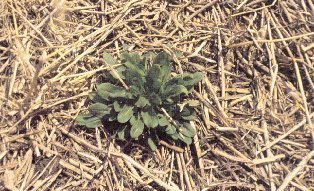 |
Weed Management Under Zero Tillage
It is important to recognize that zero tillage fields in this survey had higher densities of perennial weeds. Since conventional and zero tillage herbicide practices were very similar for these weeds, it is likely that the added benefit of tillage is helping control perennial weeds. Zero tillage producers should be aware that weeds like dandelion, perennial sow-thistle, Canada thistle and quackgrass have the potential to increase under zero tillage systems, and they should adjust their weed management programs accordingly. On the other hand, certain annual weeds seemed to decrease under zero tillage, while others seemed to increase. Zero tillage crop production could be an important method of controlling herbicide-resistant weeds like green foxtail and kochia, which appeared to decrease. However, a trade-off is involved because it appears that other annual weeds - like wild oats, cleaver, hemp nettle and round-leaved mallow - have the potential to increase under zero tillage. The similarities in weed management practices reported by zero and conventional tillage producers were far greater than the differences observed. Therefore, it seems that converting from conventional to zero tillage crop production would require relatively minor changes to the overall weed management program. However, zero tillage does require different strategies for pre-seeding weed control and control of winter annual weeds in the fall. It also requires greater emphasis on cultural weed control techniques. This fits with our understanding of zero tillage systems; the loss of tillage as a means of weed control must be compensated for by an increase in herbicide use and cultural weed control strategies. |
|
For More Information